



Detect, classify and address IT incidents centrally – with Securepoint Managed XDR and without the need for additional staff
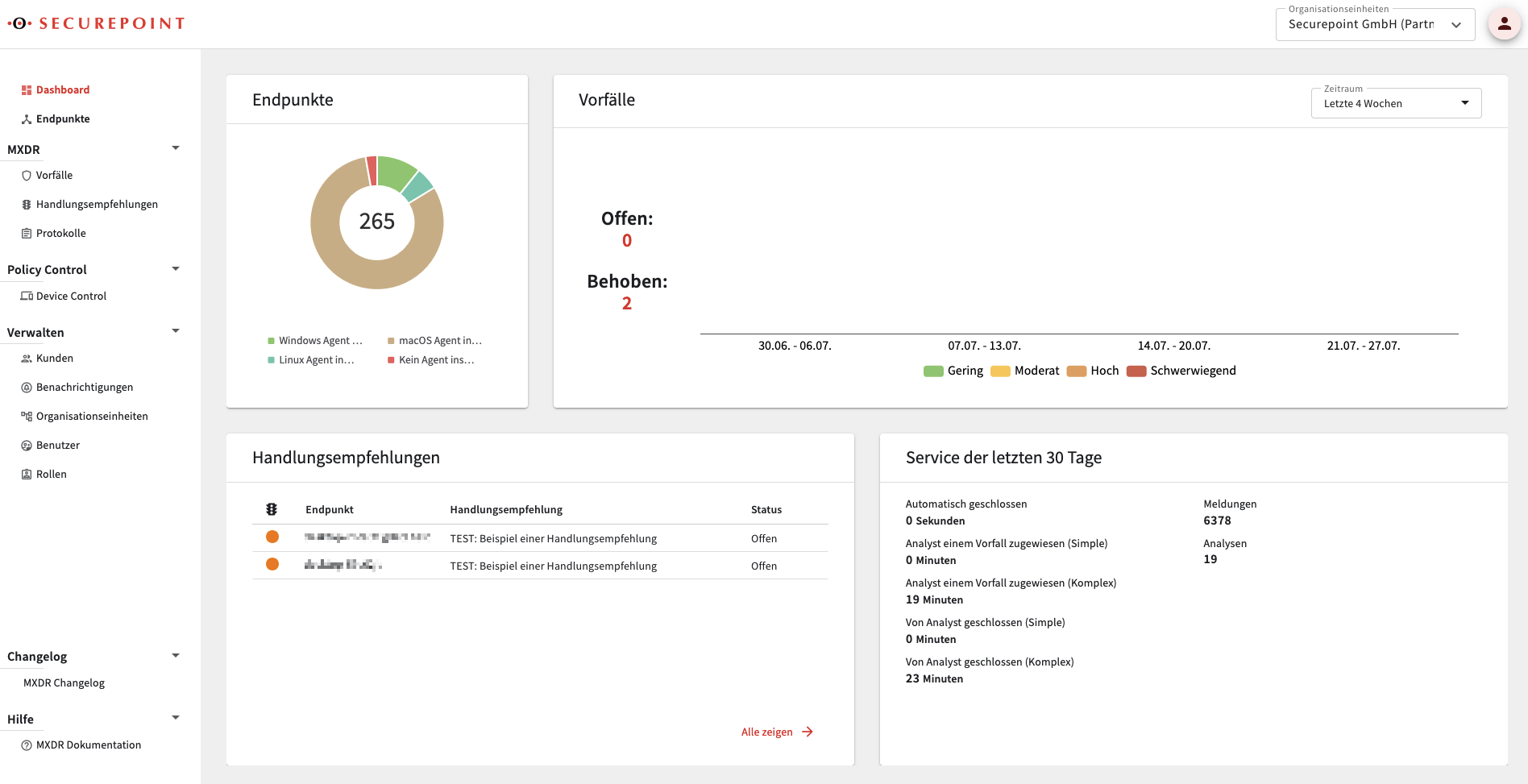
Cyberattacks are becoming more complex, faster and harder to detect. Managed XDR provides a more comprehensive view of threats and suspicious activity – from monitoring individual endpoints to detecting suspicious activity on the network.
For IT decision-makers and administrators, this means fewer isolated individual alerts, more actionable context and faster assessment of security incidents – even at weekends and on public holidays! Securepoint Managed XDR helps to detect attacks earlier, prioritise risks more effectively and strengthen IT security in the long term.
Managed XDR Features
- 24/7 monitoring by a team of analysts
- Comprehensive endpoint security with Extended Detection & Response (EDR/XDR)
- Centralised consolidation of relevant security events
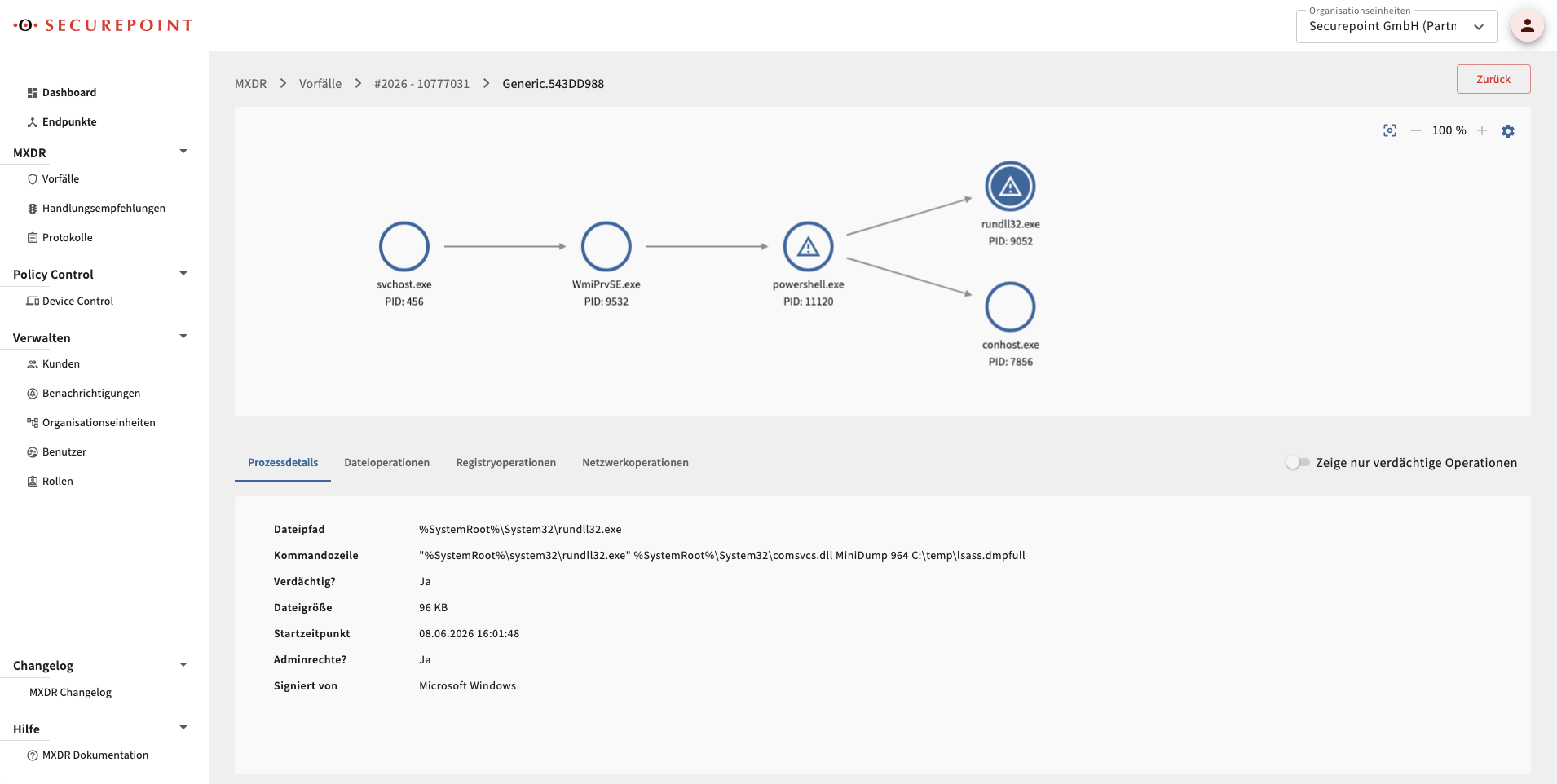
- Detection of complex and multi-stage attack patterns
- Verification and validation of incoming alerts
- Filtering of false alarms and non-critical events
- Risk-based prioritisation of genuine threats
- Clear presentation with specific recommendations for action

Why businesses need MXDR
Many organisations already have security solutions in place, such as firewalls, endpoint solutions or VPNs. The key challenge is to maintain an overview of incoming security alerts and draw concrete conclusions from them.
MXDR adds a crucial pillar to your security architecture: monitoring and response by a team of security specialists.
A modern attack rarely occurs via a single channel. Phishing, stolen credentials, malware and data exfiltration can all form part of the same attack chain targeting different endpoints. Taken in isolation, individual security alerts may sometimes appear uncritical. It is only when these events are correlated that it becomes apparent that several incidents are linked.
MXDR provides transparency in this regard. Security events are not viewed in isolation, but are contextualised: critical incidents can be prioritised more quickly, whilst less relevant alerts do not tie up resources unnecessarily. This enables IT teams to recognise more quickly whether a single alert is harmless or could be part of a larger attack.
For organisations, this means a better basis for decision-making – a decisive advantage, particularly when IT capacities are limited!
Securepoint Managed XDR – Editions
| Managed XDR | Managed XDR Pro | |
|---|---|---|
| 24/7 Detection & Response durch Security-Analysten | ✔ | ✔ |
| Managed SOC to supplement your own IT team | ✔ | ✔ |
| Cross-endpoint attack detection | ✔ | ✔ |
| Graph- and AI-based event correlation | ✔ | ✔ |
| Active response to detected threats | ✔ | ✔ |
| Web console displaying incidents and recommended actions | ✔ | ✔ |
| Email notification of an attack | ✔ | ✔ |
| Notification of an attack by telephone | ✔ | |
| Dedicated point of contact | ✔ | |
| Regular configuration checks | ✔ |
Securepoint Managed XDR for businesses and public sector organisations
Securepoint Managed XDR is aimed at businesses, government agencies and public sector organisations seeking to enhance their IT security in a professional manner. The service helps to better integrate existing layers of protection, analyse security-related events in a structured manner and respond to them in a targeted way.
Companies benefit particularly from MXDR if they use multiple layers of protection but do not wish to build up their own resources for continuous security analysis. Securepoint Managed XDR helps to turn a multitude of technical signals into actionable security intelligence.
With Managed XDR from Securepoint, you can strengthen the technical effectiveness, data protection and digital sovereignty of your IT.

MXDR makes IT security more effective
Securepoint Managed XDR enhances existing security solutions without adding complexity to your IT infrastructure. MXDR combines technology, analysis and response into a security approach that provides greater visibility into modern attack patterns. IT security experts in Germany monitor and interpret the incoming data, identify where action is required and take the necessary steps.
Security analysts review incoming alerts, filter out false alarms and prioritise genuine threats. For businesses and public authorities, this means greater transparency, faster decision-making and better utilisation of existing security solutions.
With MXDR, organisations gain transparency, reduce the workload on their IT department and enhance their security without having to set up their own SOC structures.
FAQ on Securepoint Managed XDR
MXDR stands for Managed Extended Detection and Response. It refers to a managed security service that detects and analyses threats across multiple IT domains and supports or initiates response measures.
The term comprises three key components: ‘Managed’ means that experts support operations, monitoring or analysis. ‘Extended Detection’ describes enhanced detection across multiple security sources. ‘Response’ refers to the reaction to detected threats, for example through assessment, prioritisation, recommendations for action or specific defensive measures.
Unlike individual security products, MXDR does not focus on a single, isolated area. Instead, it consolidates events from different layers of protection. This makes it possible to identify correlations that might otherwise remain hidden when considered in isolation.
An MXDR service collects, correlates and evaluates security-related events from various IT areas. The aim is to detect attacks at an early stage, reduce false alarms and enable a rapid, informed response to threats.
In practice, MXDR analyses suspicious activity, identifies potential attack patterns and helps to classify security incidents according to their severity. This may include, amongst other things, unusual login attempts, suspicious processes on end devices, unusual network traffic, malware activity or indications of compromised systems.
A high-performance MXDR service typically supports several tasks:
It detects security-related events across various layers of protection. It assesses whether an alert is genuinely critical or whether it is a false alarm. It prioritises incidents according to risk and urgency. It provides recommendations for action or supports response measures. And it helps IT teams to better understand attacks and prevent follow-up activities.
This makes MXDR an important addition for organisations that wish not only to operate their existing security solutions, but also to actively evaluate them and integrate them into an effective protection process.
Managed XDR is a security service that combines XDR technology with expert support. It provides organisations not only with technical detection, but also with assistance in analysing, assessing and responding to security incidents.
XDR stands for Extended Detection and Response. It extends traditional detection-and-response approaches beyond individual systems. Whilst an endpoint solution primarily focuses on end devices, XDR can incorporate multiple data sources, such as endpoints, the network, email servers or cloud services.
The ‘managed’ aspect is particularly important when internal IT teams are unable or unwilling to build up their own resources for continuous security monitoring. Rather than simply generating alerts, a managed XDR service helps to distinguish relevant incidents from non-critical noise and to classify attacks more quickly.
This provides organisations with a practical approach to security: the technical infrastructure supplies data and detections, whilst security experts assist with interpretation, prioritisation and response.
Yes, MXDR can also be beneficial for small businesses if they operate business-critical IT systems, process personal data or are unable to build up their own security resources. Smaller businesses in particular benefit from being able to assess security incidents more quickly and draw on external expertise.
Small and medium-sized enterprises are just as much a target of cyberattacks today as large organisations. The difference often lies in the resources available. Whilst large corporations can establish their own security teams, smaller companies have to work with limited IT capacity.
MXDR can help here by providing professional security analysis without the need to set up an in-house Security Operations Centre. This is particularly useful for companies that rely on digital processes, process sensitive customer data or have to meet high standards of availability and compliance.
Whether MXDR is appropriate in a particular case depends on the protection requirements, the existing IT infrastructure and the desired level of security. For many small and medium-sized enterprises, however, MXDR is a pragmatic way to go beyond traditional security measures.
A managed service typically focuses on the operation, maintenance and administration of individual systems. MXDR focuses on the detection, analysis and response to security threats across multiple IT areas.